Showing posts with label Amsterdam. Show all posts
Showing posts with label Amsterdam. Show all posts
Saturday, December 20, 2008
Sinterklaas, episode III: Revenge of de Sint

So this is Christmas.
And it's then normal ending for this esalogy of Sinterklaas to see what went wrong when Sinterklaas crossed the Ocean and went to America.
In fact the figure of the Santa Claus is heavily based on the character of Saint Nicholas, and especially in his Dutch version Sinterklaas.
History say that when they went to America, Dutch conquerors and settlers brought with them their traditions and habits, and within them, Sinterklaas.
Then, during the American War of Independence, the inhabitants of New York City, the former Dutch colony of New Amsterdam, reinvented their Sinterklaas tradition, as Saint Nicholas was a symbol of the city's non-English past.
The name itself of Santa Claus is supposedly derived from the old Dutch form Sinte Klaas.
Despite the fact that this historical reconstruction is not supported by all the experts, it is supported by me (and many others).
But of course also the traditionally Christian Saint Nicholas, or Sinterklaas, is in turn a clone (as all he Christian characters I may say).
The features of Saint Nicholas, a greek bishop pretty popular in Germanic Countries, is in fact molded from the casting of Wotan, the Germanic version of the chief god in Norse paganism Odin.
Odin, as his alter ego Sinterklaas, is often depicted as a old man, with a long beard, a hat and a stick in the hand.
He's ridings his eight-legged white horse Sleipnir, a grand-grandfather of het wit paard van Sinterklaas.
Also the character of Zwarte Piet, Sinterklaas' helper, in the Medioeval traditios was bearing a lot of similarities in role with Odin's ravens Hugin and Munin.
Finally, late Roman historians, such as Tacitus, used to refer to Odin by using the name of Mercury since they shared features and roles.
Ergo: Ermes is Santa Claus.
(This could explain my childish confusion in understanding the meaning of Santa Claus.)


Friday, December 19, 2008
Sinterklaas, episode II: The attack of the Piets

As I said in the previous post of mine, the description of Zwarte Piet, the companion of Sinterklaas, as a moorish slave from Spain freed by the Saint is very shaky. And even more shaky is the more politically correct portray of Sinterklaas' helper as a chimneysweep from a Southern Country that decided to follow the Sint because of gratitude.
The truth is that, according to myths from the 18th century, Saint Nicholas operates in the companionship of a devil. It is said in fact that on Saint Nicholas Eve the Saint fought the devil and triumphed over it (him?), and eventually enslaved it.
In Holland the figure of the devil was softened into less strong appearances of a moorish kid. But in other Countries in Europe, where Saint Nicholas is also warshipped, some features of the devilish nature of the Saint's helper still remain.
Saint Nicholas is celebrated mainly in the Lower Countries, but it is also very important in most of Central Europe, as well as his dark companions.
In the North of Germany, Sinterklaas helper is called Knecht Ruprecht, or servant Ruprecht. As in Holland they look like black or moorish people and they gave up their devilish appearances.
But in the South of Germany, as well as in Austra, Hungary, Slovenia, Croatia and even in the north mountainous part of our region in Italy, Friuli Venezia Giulia, Sinterklaas helper are much like devilish incubi figures, called Krampus. In those areas, young men dress up as the Krampus in the first two weeks of December and roam the streets frightening children and young ladies with rusty chains and bells.
Krampus usually wear wooden masks with huge horns, and sheep skin.
(Present idea: I'd really like to receive a Krampus mask, so if someone needs ideas for a Christmas present for me, just consider this.)
Similar to Krampus are the Bavarian and Styrian Klaubauf, while Pelzebock are more human like, as well as the Pelznickel, Belzeniggl, the American Belsnickel, the Swiss Schmutzli, Rumpelklas, Bellzebub, Hans Muff, Drapp or Buzebergt, and the France Hanstrapp and Le Père Fouettard.
Wednesday, December 17, 2008
Women in the Netherlands - what they think

After my old (and very succesful) post about the women in the Nederlands, and more specificaly, on the marvellous invention of the plastuit, here I am again, after a Women Lunch, a good occasion to see and to hear about the reality of women in the Netherlands (and actually, all over Europe and beyond).
The idea started by two women researchers in our institute that wanted to share their experience with the younger girls in the same field and have some feedback on how life's going. I am always been very committed to these kind of subjects, as on one side I don't understand how it is possible that among all the discriminations that the human being has done during history, the one on women is the most prolonged and fundamental one, that has held strongly along centuries, that exists in every culture, north and south, east and west, no matter which religion, no matter in which time it is, the discrimination on women has always been present. On the other hand, it is also clear that it is the discrimination that has been most accepted by the victim herself. Many women not only accept it, but are actually proud of being not considered at the same level as men. Well, the discussion of today was much more practical (being Dutch, we may say :-) ) and it was focused mostly on how the society helps women with a family and how it is accepted to have women in high position in a company or in science. Well, I heard a lot of complaints indeed! When I said that surely The Netherlands is not the top, but is not so bad either, I have been answered that statistics shows that women in the Netherlands works less than in the rest of Europe. So I have checked on internet, and what I found is that here 75% of the women are working part time, against the 31% of the European average. Well, it is true that probably the tradition is such that women are more likely than men to stay at home to take care of the children and the house, but if you look more carefully, also the percentage of men having a part time job in The Netherlands is way bigger then the European average. In practice, people work less, because a part time salary is very often enough to have a nice life. Well, one can argue that is often not a choice because there is a lack of childcare, and that's true, but is also true that having a part time job is not a bad thing by definition. Also because part time is not defined. Some people work at 50%, some people at 90% of the full time. The average is around 80%. And often it is for a nice and managerial kind of job. Also, I think that the main reason why in Holland you see so many women discriminations or related problems, it is because women are free to talk about it, they want to express it. I think the number of housewives in Italy is just scary, and of course all these women staying at home, claiming that taking care of the house is just as any other job, and chit-chatting with ladies friends agains men and their housband is not the right mood to fight against male chauvinism. Actually it is just a good reason to become even more chauvinist. At the end The Netherlands is a country that has chosen as main value the eguality among people, and is one of the main supporters of the CEDAW ( Convention on the Elimination of All Forms of Discrimination against Women) so I think that it may look a bit paradoxal, but the fact we can complain so much about the situation of women in the Netherlands is actually a sign of a better position of the women here then in other places. It is nevertheless true that everywhere, we are very very far from reaching the same rights and the same treatment then our male collegues, and even if it may be not very useful, it is always good to talk about that and let people reflect about this.
Sinterklaas, episode I: The Zwarte Piet menace

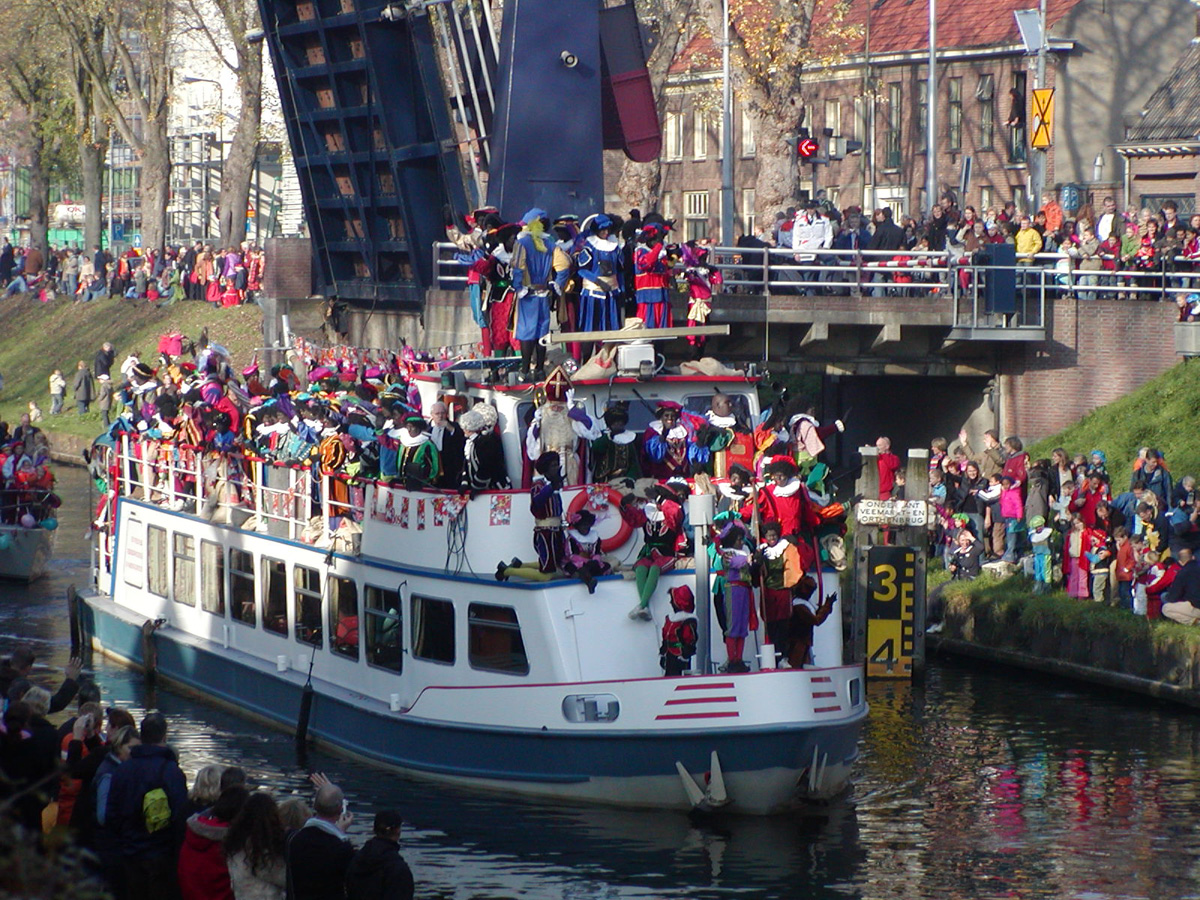
Traditions in Holland say Sinterklaas comes from Spain, and they are supported by facts: every year a dutch TV troupe films the departure of Sinterklaas and his helper Zwarte Piet from Spain (as you can see in the picture Eleonora took in Madrid two yers ago) and after a couple of weeks his arrival in Amsterdam by steamboat is greeted by many dutchmen.
Traditions today say that when in Spain, Sinterklaas freed a young moor slave sentenced to death and after that he became his little helper. A even more politically correct view teach that the dark skin of Piet comes from his job as a chimneysweep. This is supported by his clothes which remind the Italian chimneysweep's costume.
But of course the origin is another: in Christian traditions Saint Nicholas was in fact said to work with the devil himself (he's said to have enslaved the devil), and how's the devil looking?
Well, dark skinned of course.
And when this XIX century picture became too racist Zwarte Piet became "just a young slave from a non better specified South, freed by the Sint".
He's supposed to help Sinterklaas to bring presents to the good children, and to punish the bad ones.
Parents use to tell their children that if they have been good, Zwarte Piet will bring them gifts and sweets, but if they have been bad, Piet will catch them, stuff them in his huge dufflebag and send them away to Spain as punishment.
This is sort of funny: what kind of menace is to being send to Spain???
It's even more ironic if you think that Spain is nowadays the main holiday country for dutch people!
But this is something that often sounds weird to me.
The way dutch children are punished if they were bad is pretty different from what we're used to in Italy.
Another typical punishment is to force them to eat spruitjes, Brussels sprouts. This is understandable (even if I love Brussels sprouts), but the funny thing is that if they were good they will be allowed, as reward, to eat spinaches!
There is in fact a way of saying here to incourage kids, which is:
En je zult spinazie etenwhic translates as: "[if you are good] you'll eat spinaches".
This doesn't have much to do with Sinterklaas, but I like it because it's a sort of parody of another saying: "if you keep going fine, you'll become like Spinoza".
Spinoza and spinache in Dutch sound more or less the same, so they just switched to the funny version.
Have I been heavy enough? Good...
Monday, December 15, 2008
Sinterklaas, episode VI: The return of De Sint

One of the recent hit from the dutch band Bløf sings Oktober is de wreedste maand, October is the cruelest month.
Despite this, Autumn is actually one of the best season in Holland.
"It is in Autumn that Amsterdam feels like at home" as one of the main critic of our modern society had to say.
The proof of this is that the only remarkable festivity in the Dutch tradition is Sinterklaas, at the apogee of Autumn.
Moreover this is the only period in which The Netherlands offer some good stuff to eat (or some eatable stuff for good), mainly candies and sweets.
There are in fact a lot of typical Autumn sweets sold only in this period and they make the athmosphere pretty warm and Christmas-like. So yes, this is definitely the best period to visit Holland (this, and the Koninginnedag, of course).
The main sweet of the Sinterklaas period are the Chocoladeletteres: thick alphabeth letters made of chocolate. Every kid gets usually the first letter of his name, or a neutral S (for Sinterklaas) or P (for Zwarte Piet). In smaller letters, such as Js or Is, the thickness of the chocolate layer is larger, so to compensate the amount of choc-ness with bigger letters such as Ms.
Then there all kind of other candies and biscuits:
- speculaas, baked cookies with a cinnamon flavour, with some figures stamped on the rectangular front side;
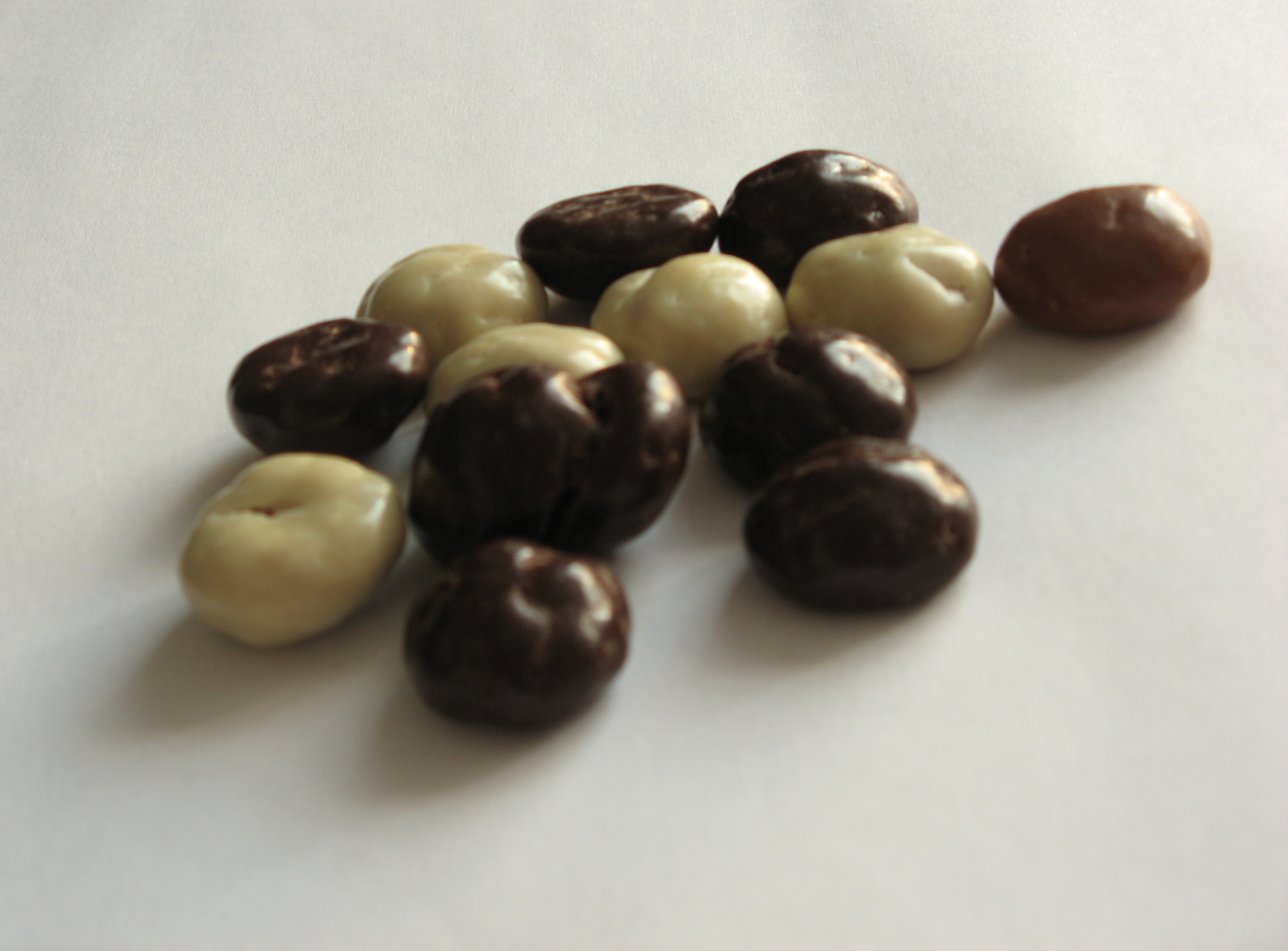
- kruidnoten, small round cookies made from the same dough as the speculaas, they exist also with a chocolate shell;
- pepernooten, not to confuse with pepernoten, they are instead made of rye. They are traditionally scatterd around to children together with coins or candies;
- marzipan! This is of course my favourite! And after last year's 2kg marzipan pig-head Eleonora bought me, this year this became a tradition and I got another one (but bigger, tastier and marzipaner)!
Eet smakelijk!
Friday, December 12, 2008
Sinterklaas, episode V: De Sint strikes back

The main aspect of the Pakjesavond, the evening of December 5th when Sinterklaas brings presents to Dutch children, is of course receiving presents.
Usually the kids find their presents the morning after, left by Sinterklaas and Zwarte Piet.
The presents are accompainied by a simple poem, called Sinterklaasgedicht, that says something about the behaviour of the child during the past year and it gives some hints to the nature of the present.
When children grow older and they quit believing in Sinterklaas, the tradition of the Pakjesavond resists and it becomes a party within friends where everybody brings a present for another person.
Usually people draw a lottery (lootje) and they pick the name of the person they will but a small present.
They also write a poem to accompain to present. Usually these poems are more ironic and teasing to the person who receives the present.
In this last case, gifts are usually creatively wrapped in weird shaped boxes the "children" have to make by themselves. Funny situations usually come out also from the un-wrapping procedure, since all kind of tricks and jokes may be used.
Sticky situations may arise: common ingredients for the filling of the gift-box may be saw dust, syrup, hair gel and cotton balls, news paper and peanut butter...
Someone told me that's also traditional to "wrap" the present within a sticky dough made of gingerbread and water and that's what I've done this year for the present I made.
So yes, we had our Sinterklaas dinner with presents, poems and all the other things and it was pretty funny (it was my first Sinterklaas in Holland, since the last two years I was defrosting in the US).
(Even if you know I'm kind of annoying about traditions.)
Saturday, December 06, 2008
Sinterklaas

Yesterday morning I woke up a bit late (even compared to average Saturdays standards).
The reason for that was the happening of the previous evening: sinterklaasavond.
Sinterklaasavond, or pakjesavond which tranlates as "presents' evening", is the main festivity in the dutch calendar and it's celebrated every year on December 5th, Saint Nicholas' eve.
Saint Nicholas, or Sinterklaas in dutch, was a Greek bishop, patron saint of children. He's celebrated in mostly all the Countries in central and eastern Europe, as well as in the most extreme eastern outposts of Italy: Trieste and Monfalcone.
He's an old guy dressed like a bishop and, in the dutch tradition, he's supposingly coming from Spain every year, riding a white horse (het Paard van Sinterklaas) and followed by his personal helper Zwarte Piet, or Black Peter, a Moorish kid that stories tell Sinterklaas resqued from prison and now, in sign of gratitude, helps him in delivering presents to children.
Sinterklaasavond in The Netherlands is a holiday especially for children, and at this time they are supposed to get presents if they were good in the past year. It's in fact Sinterklaas that brings presents in The Netherlands, not Santa Claus, la Befana (which I discover just now it's a peculiar character of Italy only), the Three Kings, any kind of italian Madonna or Child Jesus (as my grandmother used to tell me. I have to admit this separations of roles confused me a bit when I was young).
There are a lot of cooking traditions, funny ways of wrapping the presents and to write the cards, but I will talk about this later on.
(Or you can check on Wikipedia.)
Friday, November 28, 2008
Smoke under the water
There is an urban legend in Holland saying that Dutch people don't like bans, and the only way to let them follow a certain rule is to explain them its social utility.
I'm not sure if this is true, or if this is the case, but the smoking ban active in The Netherlands is definitely facing some comportamental problems.
It all started on July, 1th 2008, when also The Netherlands, one of the last Country in Europe to decide so, started to ban smoking tobacco from public closed places such as bar or restaurants.
In the Country of free Marijuana this sounded a bit weird (even if this is actually one of the few places where you could create some legal smoking rooms for almost all kind of smokers) and protests started as soon as the law was enforced.
On July, 15th dutch Café owners started to join a new religious movement called One and Universal Smokers Church of God whose worshippers are said to believe in the trinity of smoke, fire and ash and honour their god by smoking.
Dozens of bars owners asserted the Dutch constitution and European rules give it legitimacy under the right to freedom of religion.
But the government went on and the police started to give fines to those bars that let their costumers smoke inside.
Unfortunately the fine was not so high (300€ for the owner, nothing for the costumer) and it wasn't enough to persuade the bar owners.
What happened is that in many places owners put next to the door some collecting box, where costumers can throw some coins, to help pay for the potential fine.
In response, Health Minister Ab Klink decided to get tough.
In the future, he proposed, violations of the ban have to be treated as economic offences which would allow the authorities to impose fines as high as 16000€.
A lot of owners of cafes then started to strike, especially in the South.
Groups of cafe owners in cities such as Groningen, Tilburg and Breda have already agreed informally to ignore the ban.
Last weekend, cafe and bar owners in Den Bosch decided en masse to ignore it.
The war has started.
29 bars were sanctioned last weekend only in Den Bosch, while the minister announced that cafes which continue to defy the ban will be closed down for breaking competition laws (because they compete unfairly with cafes which are not breaking the law).
We'll see who'll win.
Monday, November 17, 2008
15 Miljoen Mensen (Fluitsma & Van Tijn)
After the two versions of the song Het Land van (by Lange Frans & Baas B and Salah Edin) I posted a couple of months ago, here it is another dutch song telling about this Country.
This time it's a non-rap song from 1996. Here you can find the lyrics in dutch and this is the translation:
15 million people
Country of 1000 opinions
The Country of matter-of-factness
All of us on the beach
Rusk for breakfast
The country were nobody goes full out
Except when we win [in football]
Then we have an instant bout of passion
And nobody stayed inside
The country that hates finicking
No uniform is sacred
A son who calls his daddy Pete
A bike is nowhere safe
15 million people
on that little piece of Earth
You don't tell them what to do
You just respect them
15 million people
on that little piece of Erath
You don't put them in a straightjacket
You just respect them
The country full of protest groups
No manager who's really a boss
Where curtains are never drawn
And lunch is a bun with cheese
The country full of tolerance
Except for the neighbour
The biggest question will always remain
Where he gets the money for his rent from?
The country that cares for everyone
Not even a dog eats from the gutter
With snacks from the wall [FEBO]
And nobody who eats dry bread [nobody who is poor]
Sunday, November 16, 2008
Waterschapsverkiezingen 2008

It's been already two and a half years since when I became part of the (second) Italian diaspora.
And since a while I started to think if it was morally right for me to start being interested in Dutch politics rather than keep voting at my homeland elections.
The pragmatic me suggests that Italy needs more help than Holland, by looking how things were going on during the last 14 years; the idealistic me (which I tend to follow most of the times) claims instead that it's unfair to leave a Country in search of better opportunities abroad, but still wishing to interfere with its politics.
Moreover the pain-in-the-ass me states that technically I'm due to be represented here in The Netherlands since I'm paying taxes for this Country since a while.
So the metamorphosis started.
And the opportunity came by post.
We in fact just received an envelop with the ballots and the list of candidates to partecipate at the elections for the Waterschap.
The waterschappen (Dutch for water boards) are regional governament bodies in the Low Countries.
They are charged with defending The Netherlands from water by maintaining the integrity of the water defenses around the polders, managing water barriers (dunes, dikes, quays and levees), waterways, water levels and the water quality in their regions.
Having to do with water, you can easily feel the importance of these institutions (25% of the Country is below sea level, and three main rivers cut the land in many wet slices). In fact they are among the oldest forms of local government in the Netherlands, some of them having been founded in the 13th century.
Waterschappen hold separate elections, levy taxes and function independently from other government bodies.
There are 27 waterschappen in The Netherlands covering the whole territory. The Hoogheemraadschap Amstel, Gooi en Vecht is the waterschap governing Amsterdam region and it's this the one we're going to vote for.
The general structure of these institutions consist in a general administrative body (elected by people), an executive board (elected by the administrative body) and a chairperson (appointed by the government), also called dijkgraaf, the Count of the dikes (cool, isn't it?).
Actually, asking around to some friends of mine it turned out that among common people nobody really cares about these elections and that it's just "another political charge".
Nevertheless I'll try to find out the differences between the candidates and start being interested in dutch politics.
Maybe also here there is someone that believes that Obama is tanned.
Monday, November 03, 2008
Vouwfietsen

This week I gain one more point on my Dutchness score.
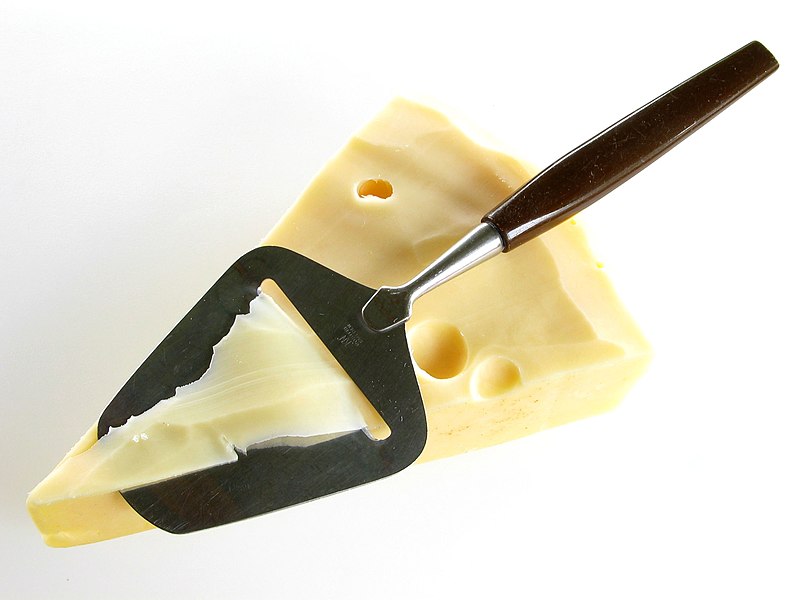
After the aardappelstamper (a potato masher ment to be used to prepare the stamppot), the eiersnijder (an egg slicer) and the legendary kaasschaaf (a cheese slicer), now I'm proud to announce that I'm finally in possession of an awesome Vouwfiets!
Which is, as the picture shows, a foldable bike (I've got it as a birthday present: thanks!).
Here in Holland this kind of bike is often used by commuters like me: people that live in one city (Amsterdam) and has to go to work to another city (Utrecht).
So instead of having a bike in each city and leave them in the train station to wait (which is what I was doing before: home -> Amsterdam train station by bike, Amsterdam -> Utrecht by train, Utrecht train station -> University by a second bike) now I can easily fold up my bike and put in on the train.
Cool, isn't it?
The bike works amazingly!
Despite the fact that the wheels are small, the gear system is smartly done and pushing on the pedals is very easy and definitely not hard.
And the bike itself is not heavier than 11 kg, so it's handy to bring it around in a folded configuration.
A last thing I discovered googling around.
The word commuting ("fare il pendolare" in Italian) is translated as "forensisme" in Dutch. Which originates from the Latin word forenses (= of the forum, the Latin market) and apparently was used to refer peasant coming to the city market from Germany to sell their goods. Then it was taken over to name in general people from the countryside that use to work in Amsterdam.
Monday, September 22, 2008
Het Land Van (Salah Edin)
Few months ago I posted the translation of a dutch rap song, Het Land Van, by Lange Frans and Baas B, two native dutch white HH-ers, grew up around Amsterdam.
Soon after another rapper, Salah Edin, mimed this song by writing a new one, with the same title, which shows another view on the dutch society, this time by a Moroccan-Dutch, son of immigrants but born in Holland.
This shows a quite more negative point of view. The lyrics in Dutch are here. This is the translation.
The Country of
The country of 1 million people with no job
The country where they do not adopt you because of your name
The country of preconceptions
The country where they force you to making problems
The country of so many laws
The country where they film you constantly for safety
The country that you'll save your ass just for convenience
The country of illegal immigrants, television scoops, politicians trying to get money out of your pockets
The country that's exposing you
The country with open borders
Full is full [C.D. anti-immigration slogan] for sure for poor people
The country of commerce
The country where people live in another dimension
The country where "tomorrow" is a trouble
The country where beautiful dreams have been spoiled
Look carefully around you because there are consequences
The country of the highest percentage of Muslim-haters
The country that has been built by our fathers
The country which considers us as danger and terror
Country of beautiful dreams, disappoints me
The country of capitalism, subcutaneous racism, materialism the country that runs on prostitution
The country of terrorism
The country of extremists
The country where you cannot spit your opinion for any reason
The country of prosperity
The country of Bakellende [literally "container of misery", it's a joke with Dutch Prime Minister's name Balkenende], the country of democracy which does not apply everywhere
The country of tolerance, meaninglessly violence, importance comes only when it's about rough money
The country of food banks, refugee camps
The country which has nothing to look for in our own Countries
The country where freedom is a mask on the face
The country of rights but what they decide is compulsory
The country of drug addicted nowadays nomads
The country that arose on the back of the slaves
The country divided in crazy districts, as they do in France to solve the problems
we call that fight, just like you do all the time
The country of colonization and now of liberalization
well, can you that compare?
The country that look for problems but then wants to avoid them
The country of schijnheilen [appearance features]
The country where everything turns around fucking oil price
The country of receivers
The country where the news has nothing to offer but lies
The country of hypocrites
Country of parasites
The country that loves to wins but gives up at losses
The country where the lion [Dutch symbol] never leave alone their shirts
The country where the woman is sold behind the window
The country where I am born and where I come from
The country that labelled me as kutmarokkaan [very bad pejorative for Moroccans]
Monday, September 08, 2008
The workers' city, far below the surface of the earth.

It is a dark time for the Rebellion.
Signs of an upcoming fascism are said to be seen all about Europe (not only in Italy) and this morning I had to face it. And just for a great luck I avoided my fate.
As every morning, I was gaily biking to the Centraal Station and, as every morning, I was going to park my bike on the racks behind the station that, as every morning, are already full of bikes in every position at 8:00AM.
After a couple of hopeless checks I decided to wedge my bike between two "official" spots already occupied and to lock it there (as half of the bikes in the rack).
It was then that I heard the grim noise of a circular saw on my back.
Suddenly three imperial clones from the municipal police came out and started to cut off all the padlocks from the bikes parked out of the racks and to throw them (the bikes) on a truck.
I then thought it was better to find a real parking spot, and so I did, leaving the clones collecting all the outlaw bikes (some 50 of them) and chopping the padlocks with that bloody saw of their.
When I came back from work tonight just a few bikes were still there (the ones in the right parking spots) and all around there were groups of astonished dutch; desperate people trying to figure out what happened to their bikes and throwing themselves like mad in the water. (OK, this can be a bit romanticized.)
I then took my bike and went back home, gaily, even if I almost got caught by some policemen because my front light was not working (since 2 days).
Fortunately they were busy screaming to a guy to drive his scooter (with the yellow plate!! Not with the blue one! But this is another story) on the bicycle lane.
Wednesday, September 03, 2008
De Bijbelgordel

Since I've been pointed out by a (the) reader that here in The Netherlands there is a so called Bible Belt, I made my homework and I tried to inquire about this.
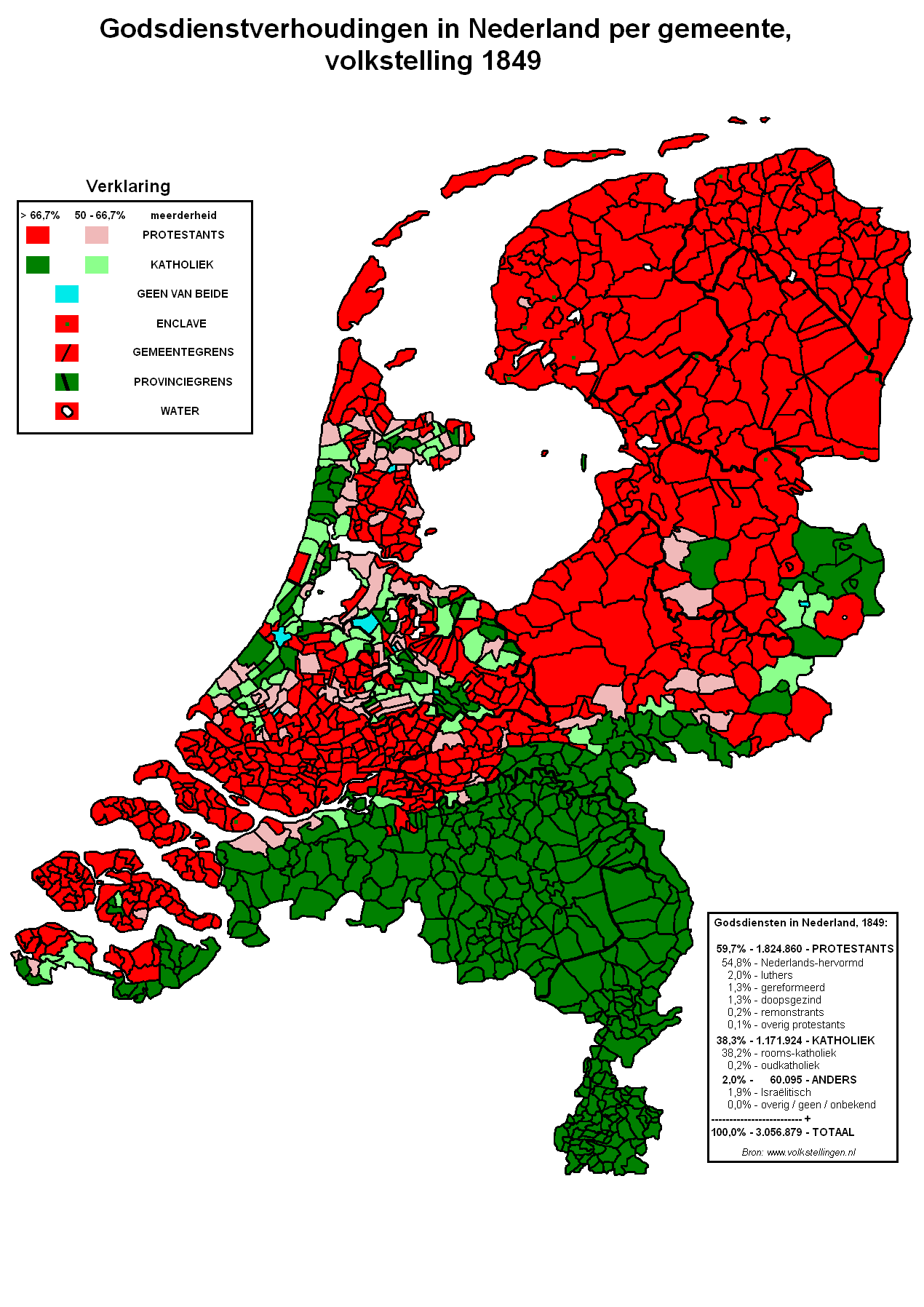
So there is indeed a bible belt also here in The Netherparts (in dutch it's de bijbelgordel) and it's basically a strip of villages inhabited mainly by conservative Protestants.
The Belt can be identify by looking at those towns where the SGP (Staatkundig Gereformeerde Partij, Political Reformed Party) is getting most of its votes.
The SGP is an orthodox Protestant party whose ideology is pretty much based on the principles of the Christian Reformed Churches and the Reformed Congregations (known colloquially as zwarte-kousenkerken, “black stockings churches"): government based on the bible, against feminism and female suffrage, in favour of the re-introduction of the death penalty, and other nice ideas like these.
The origin of this Belt is not clear, but I think it's a mix of geographic isolation (those villages are located in reclaimed lands, polders, along the depressions at the outlets of the big rivers) and proximity to the border with the Catholic part of the Country.
After Flanders and Brabant were conquered by the Spaniards (Eighty Years' war) the Protestants inhabitants of those areas were forced to emigrate north of the border (the rivers) and there they reclaimed stronger and more orthodox positions from the Dutch Reformed Church in order to protect their beliefs.
This led to a schism in 1832 (nadere reformatie: further reformation) that created more conservative congregations along the border with the Catholic communities, such as those that now are followed in the Bible Belt.
Moreover I think they are still there nowadays because they feel themselves as a sort of contrast with the very liberal general politics of the Country (they are of course against gay rights, abortion, euthanasia, cannabis, &c).
What do they do?
They wear traditional clothes, they have large families and they emphasise traditional values (such as not working during holy-days). Most of them are also against "interfering with the design of God about health" so they don't vaccinate their children (this caused a few epidemics of polio and parotitis in the last decades, very localized in those areas) and they tend not to have any health insurances.
What do the city dwellers think about them?
Some of the people I asked just say "I don't really care, they're not annoying anybody" (meaning that there are other religious group that actually annoy?).
Some other instead look at them as some weird remainders from the past that are leaving out of the big cities, in the countryside (is this why Holland an The Netherlands are almost synonyms?).
What about me?
Well... I'm trying hard to convince Ele to have a instructive tour of De Bijbelgordel of course!!
I have already a couple of pa(l)pable destinations.
The only thing I have to keep in mind is not to go there on Sunday because I've been told the inhabitants don't like to see people driving in their villages during Sundays.
Monday, August 25, 2008
... with supreme visions of lonely tunes

Since July, 1st also here in The Netherlands smoking is banned in public places such as restaurants, cafés, bars, &c.
This is done in order to prevent employees to work "in an environment were they are constantly exposed to the harmful effects of smoking", as prime minister Balkenende said.
The obvious question that come to mind is: "Holland? Smoking ban??? And what about Coffee shops???"
Exactly.
This ban works far all places, included coffee shops. "Coffee shops will be treated in the same manner as other catering businesses. They will be smoke-free".
But... of course there is a but because we're in Holland.
But coffee shop owners argued that the ban only applies to tobacco, and just for it!
This means that you're still not allowed to smoke tobacco, not even in coffee shops, but you can still smoke cigarettes containing only cannabis!
"The Dutch ban, which prohibits tobacco smoking in all public places of employment to protect workers’ health, is only for tobacco and makes no change to marijuana policy" said Saskia Hommes, a spokeswoman for Dutch Health Minister. "The government will have to see if the law is enforceable" she said.
To me this does not make so much sense.
I mean: coffee shops are places built for let people smoke inside freely. And the owners or the employees know that if they go to work for a coffee shop they're going to sniff all others' smoke.
If you decide that smoking and to sell marijuana is legal, than you should also allow places where people can smoke freely, no?
But anyway selling marijuana is not legal in The Netherlands, it's just not punishable. Really.
Is this hypocrisy or just a pragmatical way of trying to solve an unsolvable problem?
Monday, July 21, 2008
Holy smoke!
Here we are after our Japanese honeymoon.
I'll leave to Ele to explain all the nice things we saw in Japan (it was really awesome!) because we need to set finally up the winner of the Euro 2008 ugly bets, which is....
.... Giovanni (van Bronkhorst)!!!
Unperishing glory for him and may he live in eternity lying in the gardens where there are rivers of milk of which the taste never changes, rivers of wine, a joy to those who drink, and rivers of honey pure and clear.
(Still I'm not sure I'd like to swim in rivers of honey...)
In the meantime, while we where honeymooning in Japan and Giovanni was mooning over honey rivers, the Dutch founded a new Church, the One and Universal Smokers Church of God, after the new law banned smoking in the Dutch bars since July 1st (Good morning Holland!).
People who join the church get a membership card entitling them to smoke inside the building. Worshippers believe in the trinity of smoke, fire and ash and honour their god by smoking.
Dozens of bars have joined the movement which claims the Dutch constitution and European rules give it legitimacy under the right to freedom of religion.
Good mooning, Holland.
Wednesday, June 25, 2008
Klein bottles of Heineken

What does it happen when you give a lot of money (with respect to an average Italian PhD salary) to a high and very specific educated youngster that uses to spend his/her life thinking about nonsense?
He/Her will start spending all this money (and a bit more) in buying the stupidest and most useless thing traceable on internet.
Last thing I bought from California is in fact an original Klein Bottle made of glass (actually it's a 3D immersion of a real 4D Klein Bottle)!! Cool, isn't it?
I didn't find a use for it yet, but - come on! - I had to buy a zero volume bottle!
(And I am not even high educated yet!)
But now let's be serious. There is a drama going on.
The Chinese authorities have banned the import of traditional Dutch deep fried rissoles known as bitterballen during the Olympics (the Telegraaf reported yesterday)!!!
The bitterballen were destined for the Heineken House ("a Dutch-style cafe for fans and athletes") but it come out they contain Brazilian meat, which is banned in China.
But don't despair!
Producer Van Dobben is now considering to set up a temporary production line just for China. So stay tuned: if we're lucky the world will be safe!
Monday, June 23, 2008
Hairy moments for bald youngsters

Here we are.
Back in the low (and cold) Holland after this disastrous football week-end.
I was hoping to watch another Holland-Italy in front of bowl of bitterballen and at the end I find myself here waiting for Russia-Spain...
So my plan to see what would have been going on here with the Oranje winning the Championship is gone.
I will not see crazy Dutch jumping into the canals, deep-frying orange scarfs, kissing each other... and maybe even step down from the bike!
All of this is gone forever... like teardrops (of sweat) in the rain...
But never mind!
I'll be traveling on Sunday to Japan so no final anyway.
Moreover the Dutch decided (according to a poll made over a sample of 1 drunk Dutch) to support Russia now. And I'll go back supporting Denmark again.
Also the government decided to rise some of the 80km/hour speed limits around Amsterdam and Utrecht and if it's meant for cars (and not for bikes) it's cool.
Does this have something to do with the results of the Championship?
Wednesday, June 11, 2008
Life is.. a cosmic symphony
Hello,
from now on the ranking over the (ugly) bets for Euro 2008 will stay on the right side of the blog (can you see it?) so that we will be able to post some other bullshit here.
So, to inaugurate the bull's year, here there is a new advertisement for the dutch beer Bavaria.
Life is...
Sunday, June 08, 2008

Subscribe to:
Posts (Atom)
ShareThis


 Posts
Posts